Nutrition Research Brief2026-07-06Choose less-stripped dairy for MFGMA July 3, 2026 Advances in Nutrition meta-analysis found that bovine MFGM/MPL modestly lowered LDL, total cholesterol, ApoB, and TC:HDL in short RCTs. The practical takeaway: if dairy already fits your diet, favor unsweetened, less-stripped dairy over automatically choosing skim or sweetened low-fat options, while keeping saturated-fat and LDL caveats explicit.
Nutrition Research Brief2026-06-29Diet weight loss can fool eGFRA new Frontiers in Nutrition meta-analysis found that diet-driven weight loss may make creatinine-based kidney markers look better without improving measured filtration, so rising eGFR during dieting should be interpreted cautiously.
Nutrition Research Brief2026-06-28MW tea lowered meal glucose in 20 adultsA small randomized crossover trial found that a 95:5 mulberry leaf and water chestnut husk tea lowered post-meal interstitial glucose after a rice breakfast and showed a moderate second-meal effect at lunch. The practical takeaway is conservative: unsweetened mulberry-leaf tea may be reasonable to try before high-starch meals, but the evidence is limited to a 20-person acute study in healthy young adults.
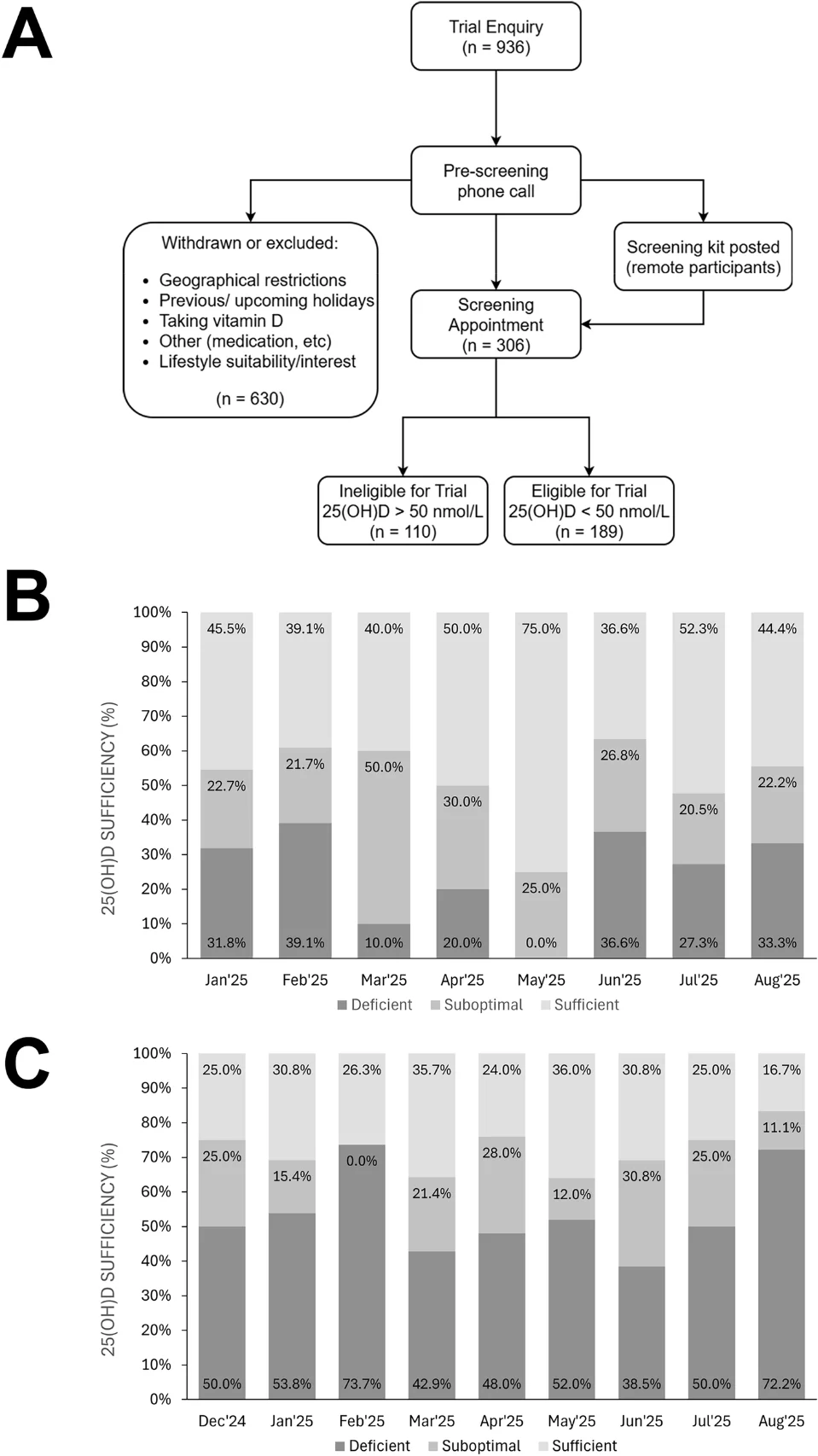
Nutrition Research Brief2026-06-26Summer did not fix vitamin D levelsA new European Journal of Clinical Nutrition screening study found that vitamin D insufficiency stayed high among older adults and adults with darker skin in northern Britain, even during summer. The practical takeaway is to treat vitamin D as a year-round intake issue for higher-risk groups and follow the 10 micrograms/day guidance rather than stopping supplementation when the weather improves.
Nutrition Research Brief2026-06-25A small RCT says DHA during breastfeeding boosts infant brain development. A 16× larger trial disagrees.A June 2026 Frontiers in Nutrition RCT (Gupta et al.; n=60) found that DHA supplementation during lactation significantly improved infant neurodevelopmental scores at 6 months. The far larger DHANI trial (n=957; 400 mg/day algal DHA) found no benefit at 12 months. The article breaks down both studies, explains the contradiction, and closes with a concrete recommendation: meet the 200–300 mg/day DHA threshold through fatty fish 2–3×/week or an algal supplement — but don't treat supplementation as a guaranteed developmental intervention.
Nutrition Research Brief2026-06-24Beetroot juice raises VO₂max in recreational exercisers — a 38-trial meta-analysis finally isolates the effectA June 2026 systematic review and meta-analysis in Frontiers in Nutrition (Qin & Kim; 38 trials, 703 participants) is the first study to isolate VO₂max as a primary outcome for beetroot juice supplementation. The pooled effect is small but significant (SMD = 0.24; moderate GRADE certainty), and it concentrates almost entirely in recreational exercisers (SMD = 0.38) — highly trained athletes show no significant benefit (SMD = 0.07). Effective protocol: ≥ 6.4 mmol nitrate/day for at least 3 consecutive days, from a dose-verified source.
Nutrition Research Brief2026-06-23Eating dinner alone is associated with twice the odds of depression in older adults — a 21-study meta-analysisA 21-study meta-analysis in Frontiers in Nutrition (Zhang et al., 2026) finds that eating dinner alone is associated with more than double the depression odds in older adults (OR 2.13). The article covers study methodology, the counterintuitive nutritional intake findings, a full limitations section, and a four-part actionable recommendation for clinicians, caregivers, and health-conscious adults over 60.
Nutrition Research Brief2026-06-22You don't need a perfect Planetary Health Diet — moderate adherence already moves the curveA June 2026 Bayesian dose-response meta-analysis in Preventive Medicine (Khuc et al., 23 prospective cohort studies) finds that mortality and CVD risk reductions from the EAT-Lancet Planetary Health Diet begin at moderate adherence — not only at the highest tier — with 17% lower all-cause mortality, 16% lower cardiovascular mortality, and 18% lower total CVD risk at highest vs. lowest adherence. Myocardial infarction showed no significant association. The concrete takeaway: a plant-heavy daily pattern with whole grains, legumes, vegetables, and nuts — and red meat capped at one serving per week — is enough to sit in the part of the dose-response curve where risk is meaningfully lower.
Nutrition Research Brief2026-06-2150 mg a day: the anthocyanin dose that moves cardiometabolic markersA June 2026 AJCN meta-analysis by Cassidy & Nirmala (Queen's University Belfast) — the largest anthocyanin–heart-health synthesis to date, pooling 18 prospective cohort studies and 65 RCTs — finds habitual high anthocyanin intake associated with 26% lower CVD incidence, while doses as low as 50 mg/day improve blood flow, arterial elasticity, and insulin levels in controlled trials. Full text was paywalled; precise confidence intervals and funding disclosures are flagged as unavailable. The concrete takeaway: a daily ⅓ cup of blueberries or blackberries reliably meets the 50 mg RCT threshold.
Nutrition Research Brief2026-06-20Daily sauerkraut cuts systolic blood pressure ~2 mmHg — fresh or pasteurized, it doesn't matterA 2026 randomized crossover trial (n=87 healthy adults, EJCN) finds 100g/day sauerkraut reduces SBP ~2 mmHg; pasteurized works as well as fresh; no CRP or glucose benefit in overall population.
Nutrition Research Brief2026-06-19Allulose vs. tagatose: a 20-trial meta-analysis finds both cut post-meal glucose spikes — but only tagatose lowers HbA1cA 2026 systematic review and meta-analysis in The American Journal of Clinical Nutrition (Osborn et al.; 20 controlled trials, 1,033 adults) finds that both allulose and tagatose significantly reduce post-meal blood glucose and insulin spikes with moderate GRADE certainty. The key differentiator: tagatose also reduced HbA1c by 0.25 percentage points (95% CI −0.44 to −0.06; moderate certainty), a signal absent in allulose's 12-trial pool. Neither sweetener affected body weight, lipids, or body composition. Allulose is the practical default for reducing post-meal spikes; tagatose has the edge for long-term glycemic control. Actionable recommendation: swap table sugar for 1–2 teaspoons of allulose daily, or tagatose if sourcing it is feasible.
Nutrition Research Brief2026-06-18Hesperidin cuts CRP by 0.43 mg/L in overweight adults — but only supplements can reach the effective doseA meta-analysis of 16 RCTs (n=845 overweight/obese adults) finds hesperidin supplementation reduces hsCRP by −0.43 mg/L with moderate GRADE certainty — a signal absent in the prior 2023 broader-population meta-analysis. Reaching the effective dose (~500 mg/day) through diet alone would require roughly four glasses of OJ from concentrate daily; supplementation is the only practical route. The article covers what distinguishes this from prior null findings, a full food-source dose comparison, key limitations (the paper is accepted but not yet typeset), and closes with a concrete supplement protocol for both health-conscious adults and dietitians.